
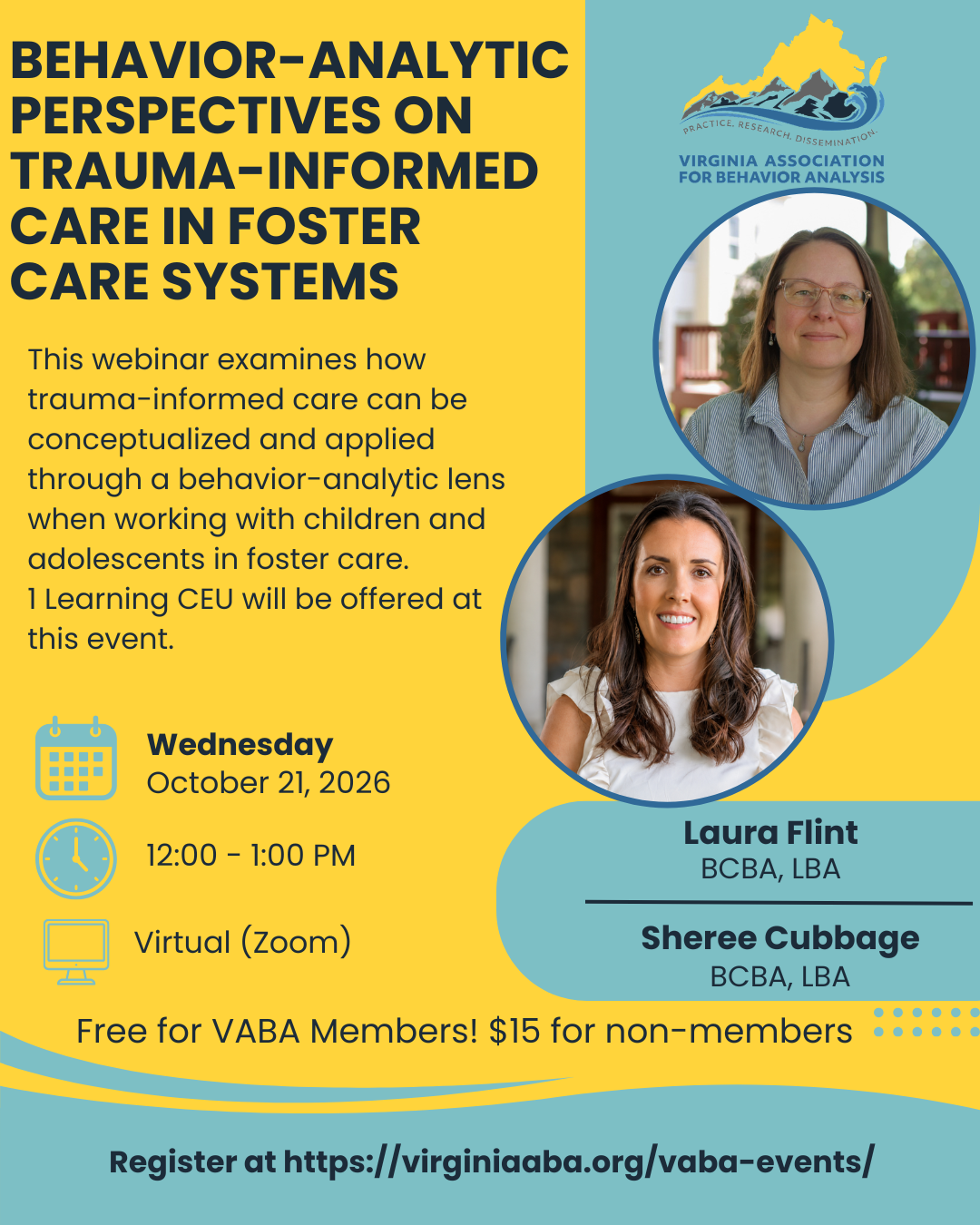
Behavior-Analytic Perspectives on Trauma-Informed Care in Foster Care Systems
Click Here to Register*
*Please note this webinar is free for VABA members. Non-members may attend for $15.00 (plus 3%+.30 service fee)
Want to attend all of our webinars for free? Become a Member
Title: Behavior-Analytic Perspectives on Trauma-Informed Care in Foster Care Systems
Speakers: Laura Flint, BCBA, LBA, and Sheree Cubbage, BCBA, LBA
Speaker Info:
Laura Flint is a Board Certified Behavior Analyst/Licensed Behavior Analyst. Currently Laura serves as the Executive Director of People Places, a non-profit foster care agency serving the Harrisonburg, Staunton and Charlottesville communities. Over the past year, she has partnered with Sheree Cubbage to develop an ABA-based consultation service focused on supporting foster care placement stability through parent training. She has worked in the human services field for over 20 years in a variety of clinical and supervisory roles, including Associate Director of a sexual assault crisis center, supervisor of a Therapeutic Day Treatment Program, and as a clinician providing in-school behavioral support, parenting education, and mental health services for adults with severe mental illness. Her passion is ensuring that children and families in our community have access to innovative and high-quality services. Laura is passionate about providing trauma-informed, evidence-based care and has presented nationally on autistic catatonia. She is also the mother of two adult children with autism spectrum disorder, which gives her a unique blend of professional expertise and personal insight in supporting children and families.
Sheree Cubbage is a Board Certified Behavior Analyst and Licensed Behavior Analyst working within a therapeutic foster care agency, where she provides consultative caregiver coaching to foster parents and oversees prevention programming supporting children and families at risk of displacement or working toward reunification. She brings over a decade of experience across community-based prevention services, educational settings, and in-home ABA services, with her work grounded in trauma-informed care, evidence-based behavioral interventions, and a systems-oriented, family-centered approach. Her clinical focus in foster care centers on supporting caregivers in implementing trauma-informed behavior support strategies that promote safety, stability, and skill development for children with complex trauma histories. She emphasizes understanding behavior within the context of trauma, attachment disruption, and environmental factors while equipping caregivers with practical strategies that strengthen placement stability and family functioning. She is committed to advancing trauma-informed, behavior-analytic practices that improve outcomes for children in foster care and strengthen caregiver capacity within complex family systems.
Description:
This continuing education presentation, Behavior-Analytic Perspectives on Trauma-Informed Care in Foster Care Systems, examines how trauma-informed care can be conceptualized and applied through a behavior-analytic lens when working with children and adolescents in foster care. Youth in foster care are disproportionately impacted by complex trauma experiences, including abuse, neglect, disrupted attachment, and multiple placement transitions, which shape learning histories and influence behavior across settings. The course applies behavior-analytic principles to understanding behavior within foster care systems, grounded in trauma-informed care, with attention to how adverse conditioning experiences contribute to learning histories and behavior patterns. Emphasis is placed on environmental contingencies, establishing operations, and other contextual variables that influence behavior over time. Participants will examine how trauma-related learning histories, including adverse conditioning experiences, interact with current environmental conditions to influence behavior across home, school, and system settings. This interaction supports a more contextually informed interpretation of behavior. Behavior is analyzed within a behavior-analytic conceptual framework, with emphasis on distinguishing between historical learning experiences and present-day contingencies of reinforcement. Overall, this presentation supports BCBA practitioners in applying trauma-informed care principles within complex foster care systems using core behavior-analytic concepts.
Learning Objectives:
Participants will:
- Conceptualize trauma-related behavior within foster care populations using a behavior-analytic framework, including the role of adverse conditioning experiences in shaping learning histories and behavior
- Identify environmental contingencies, establishing operations, and contextual variables, including patterns of stress-related responding, that influence behavior in foster care systems
- Analyze the interaction between trauma-related learning histories and current environmental conditions in shaping behavior across settings
- Distinguish between behavior influenced by historical learning experiences and behavior maintained by current contingencies of reinforcement, and apply trauma-informed care principles to behavioral interpretation
Want to share this event at your workplace? Download this flyer-ABA in Foster Care
