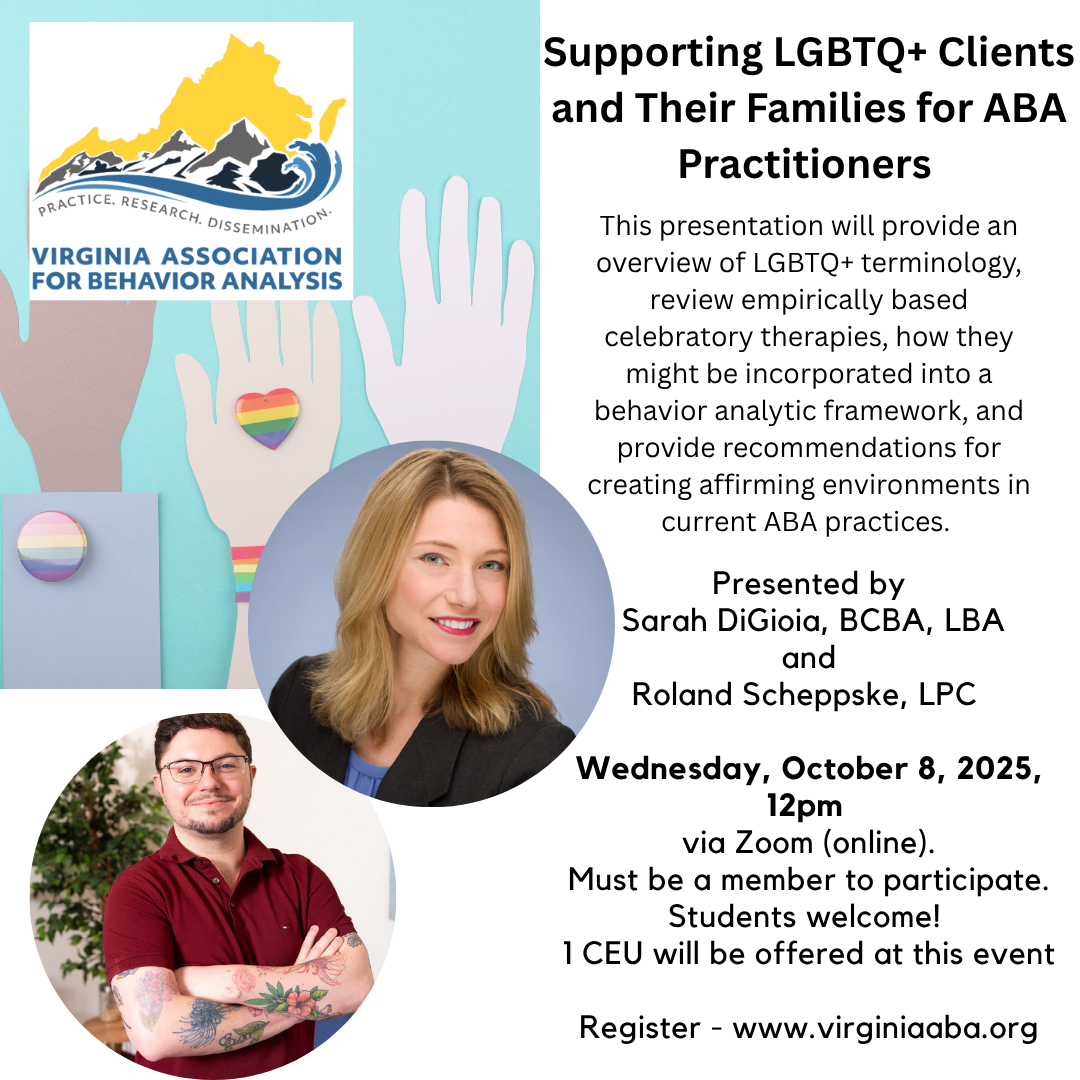
Supporting LGBTQ+ Clients and Their Families for ABA Practitioners
Click Here to Register
Become a Member
VirginiaABA Presents: Supporting LGBTQ+ Clients and Their Families for ABA Practitioners
Speakers: Sarah DiGioia, BCBA, LBA and Roland Scheppske, LPC
Speaker Info:
Sarah E. DiGioia, M.S., BCBA, LBA (she/her)
Sarah holds a bachelor’s degree in human services from Elon University, a master’s degree in special education from Johns Hopkins University, and a Certificate in Applied Behavior Analysis from George Mason University. She began her career in education as a special education teacher, later advancing to the role of district-level Autism Specialist for a public school system. In 2010, Sarah attained certification as a Board Certified Behavior Analyst, transitioning to work as a behavior specialist within a public school system. After nearly two decades in educational settings, Sarah transitioned to clinic-based work, occupying roles such as clinical supervisor, associate clinical director, regional director, director of clinical services, director of training and supervision, and owner.
Sarah’s professional interests encompass adolescent and adult populations, organizational behavior management, supervision, and ethics. Currently, she serves as the Administrative Director for the Virginia Association for Behavior Analysis and operates independently as a consultant, offering advisory services to schools and clinics, including supervision and mentorship.
Additionally, Sarah volunteers as a facilitator for the Cool Aspie Club of Alexandria, a social organization supporting adults on the autism spectrum and their allies. Sarah is actively involved in her local running community, and enjoys cooking, traveling, and spending time with family and friends.
Roland Scheppske, LPC (he/him)
Roland is a Licensed Professional Counselor with LGBT Counseling Collaborative PLLC. With over 12 years in the healthcare field, Roland utilizes the relationship between the client and therapist to facilitate forward growth and healing, with the goal of becoming the best version of themselves. Roland uses a variety of therapeutic approaches, including experiential and reality-based approaches to highlight implementing changes in the here & now. As a big proponent of creating connections, Roland makes the therapy setting conversational and comfortable to promote safety and collaboration in the therapeutic space.
Roland particularly loves working with the aromantic and asexual community, young adults experiencing delayed independence (previously termed “failure to launch”), ethical non-monogamy/poly relationships and curiosity, queer veterans and military members and their families, those with people pleasing tendencies, the gay male population, and people wanting to work on improving their abilities to self-advocate and empower themselves. He also works with anxiety, depression, trauma, other LGBTQIA+ issues, spirituality/religious trauma (or “church hurt”), & other men’s issues. He has a special passion for working with gender diverse populations who have come out earlier in life and has extensive experience working with cis, het individuals and adolescents (17+) as well.
Description:
Behavior Analysts and trainees must apply culturally responsive and inclusive practices when providing services and supervision (Ethics Code 1.07). Because LGBTQ+ individuals are members of a stigmatized class, it is crucial for us as service providers to address barriers faced by clients and their families while practicing only within our identified scope of competence (Ethics Code 1.05) and maintaining the integrity of the science. This presentation will provide an overview of LGBTQ+ terminology, review empirically based celebratory therapies and how they might be incorporated into a behavior analytic framework and provide recommendations for creating affirming environments in current ABA practices.
Learning Objectives:
- Participants will learn how to use and apply LGBTQ+ terminology within the context of ABA practices to ensure inclusive communication and service delivery.
- Participants will review celebratory therapies that align with a behavior analytic framework, fostering affirming and supportive environments for clients and their families.
- Participants will explore strategies to address barriers faced by LGBTQ+ clients and their families while maintaining ethical standards and practicing within professional competence.
- Participants will learn to create an affirming and culturally responsive environment in ABA settings that upholds the dignity and rights of LGBTQ+ individuals and their families.
